Table of Contents
- Identifying Crack Types on a Concrete Pool Deck
- What You’ll Need: Tools for Concrete Deck Repair
- Best Concrete Crack Filler for Pool Decks
- Step-by-Step: How to Fix a Cracked Concrete Pool Deck
- Sub-Surface Moisture and Expansion Joint Considerations
- Resurfacing vs. Spot Repair: Which One Do You Need?
- Preventing Concrete Cracks Around Your Pool
- Conclusion
Last Updated: August 11, 2026
Identifying Crack Types on a Concrete Pool Deck
A cracked concrete pool deck is more than an eyesore. Left unaddressed, cracks allow water infiltration that accelerates freeze-thaw damage, undermines the substrate, and creates slip hazards. The first step to fixing any cracked concrete pool deck correctly is knowing exactly what you’re dealing with. Not all cracks are created equal, and the wrong repair material on the wrong crack type is the most common reason repairs fail within a year.
Hairline Cracks vs. Structural Cracks
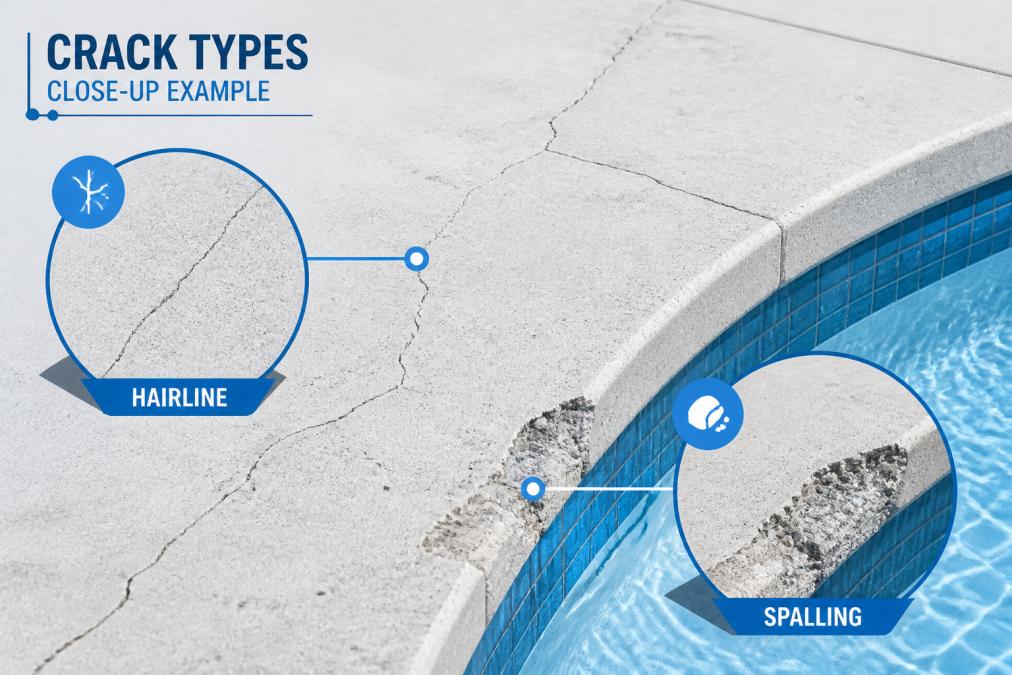
Hairline cracks are surface-level fractures less than 1/8 inch wide, typically resulting from normal concrete curing shrinkage, minor thermal expansion, or UV exposure. They don’t compromise structural integrity but invite moisture penetration. Water works into the substrate and freeze-thaw cycles widen them progressively.
Structural cracks are wider than 1/4 inch, run deep into the slab, or show vertical displacement where one side sits higher than the other. These indicate substrate movement from soil settlement, tree root pressure, or hydrostatic pressure. Structural cracks require epoxy injection or full-section replacement, not surface patching.
A practical rule: if you can fit a quarter into the crack, treat it as structural until proven otherwise.
Spalling, Scaling, and Surface Deterioration
Spalling and scaling are different from cracking but often appear together. Spalling refers to chunks of concrete breaking away, usually from freeze-thaw cycling, rebar corrosion, or poor original pour. Scaling is flaking of the top layer, often from deicing chemicals, low-quality finishing, or pool chemical exposure.
Both conditions compromise bond strength for repair materials. According to Portland Cement Association guidance on concrete repair, surface preparation is the single most critical factor in repair durability. Applying patching compound over spalled or scaled concrete without proper prep guarantees delamination.
What You’ll Need: Tools for Concrete Deck Repair
The tools needed for concrete deck repair determine your result as much as the materials do.
Essential tools for DIY concrete deck repair:
- Angle grinder with diamond blade for widening hairline cracks
- Pressure washer (minimum 2,000 PSI) for surface preparation
- Wire brush and stiff-bristle brush for debris removal
- Margin trowel and finishing trowel for applying patching compound
- Caulk gun for elastomeric caulk or polyurethane sealant
- Shop vacuum to remove dust from cracks
- Concrete sealer applicator (roller or pump sprayer)
- Safety glasses, work gloves, and dust mask rated for concrete dust
For deeper structural work, epoxy injection kits require ports, injection syringes, and surface paste, available at masonry supply stores. Professional assessment adds real value for structural cracks.
| Tool | Purpose | DIY-Friendly? |
|---|---|---|
| Crack chaser / angle grinder | Widen crack for better filler bond | Yes, with care |
| Pressure washer | Surface preparation and cleaning | Yes |
| Margin trowel | Apply and finish patching compound | Yes |
| Caulk gun | Apply elastomeric caulk or sealant | Yes |
| Epoxy injection kit | Fill deep structural cracks | Moderate difficulty |
| Concrete sealer sprayer | Apply protective sealer coat | Yes |
Best Concrete Crack Filler for Pool Decks
Choosing the best concrete crack filler depends on crack width, depth, location, and whether the crack is active (still moving) or dormant. Using rigid filler on an active crack leads to re-cracking within months.
Elastomeric Caulk and Polyurethane Sealant
For hairline to medium-width cracks (up to 1/2 inch), elastomeric caulk and polyurethane sealant are the workhorses of pool deck repair. Elastomeric caulk is flexible, moving with concrete through thermal expansion and contraction without cracking. This flexibility is critical around pools where temperature swings are constant.
Polyurethane sealant offers excellent UV resistance and strong adhesion to concrete. Both materials are waterproof once cured, preventing further moisture infiltration. For cracks near expansion joints or in areas prone to movement, these flexible fillers outperform rigid products.
Epoxy Injection for Deeper Structural Cracks
Epoxy injection is the standard approach for structural cracks running through the full slab depth. The process involves drilling injection ports along the crack, sealing the surface with epoxy paste, then injecting low-viscosity epoxy resin under pressure. Once cured, the epoxy bond is typically stronger than surrounding concrete.
The limitation is that epoxy is rigid and will re-crack if underlying movement hasn’t been resolved. As the American Concrete Institute’s repair guide notes, epoxy injection addresses the symptom, not the cause. If soil settlement or hydrostatic pressure is driving the crack, those issues must be resolved first.
Color Matching and Aesthetic Blending
Patching compounds rarely match surrounding concrete exactly, especially on aged decks. A technically perfect repair that looks like a gray patch on a tan deck is still an eyesore.
Several strategies help:
- Integral pigments: Add concrete pigment to patching compound to approximate existing deck color. Test on a small area first.
- Concrete stain or dye: Apply penetrating stain over the entire deck after repairs to unify color and hide patches.
- Microtopping or concrete overlay: A thin overlay applied over the full deck eliminates color mismatch and gives a fresh, uniform appearance.
Step-by-Step: How to Fix a Cracked Concrete Pool Deck
Fixing a cracked concrete pool deck correctly follows a clear sequence. Skipping steps, particularly surface preparation, is the primary reason DIY repairs fail prematurely.
Step 1: Surface Preparation and Cleaning
Surface preparation is not optional, it is the repair.
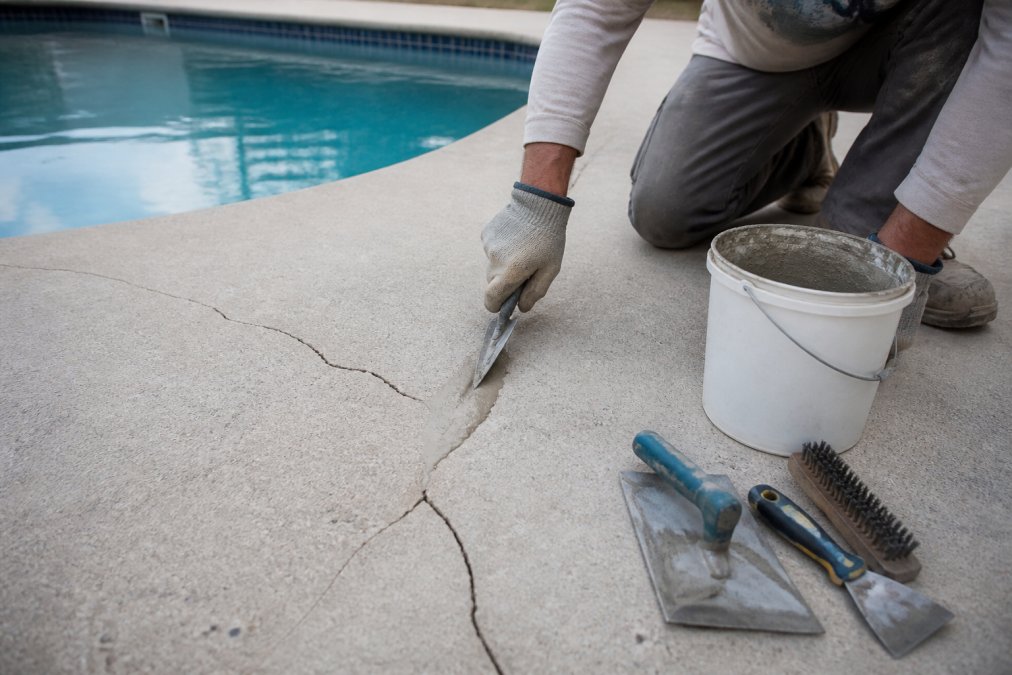
Pressure wash the entire deck to remove dirt, algae, pool chemicals, and existing sealers. Allow complete drying. Use a crack chaser blade on an angle grinder to widen the crack to at least 1/4 inch wide with a clean V-groove or U-groove profile. This gives filler material enough surface area to bond properly.
After grinding, vacuum out all dust and loose aggregate. Any debris left in the crack prevents adhesion. For contaminated cracks, a wire brush followed by another vacuum pass is worth the extra time.
Step 2: Widen, Fill, and Seal the Crack
For hairline to medium cracks, load elastomeric caulk or polyurethane sealant into a caulk gun and apply in a continuous bead, slightly overfilling. Tool the surface smooth with a margin trowel or gloved finger, then allow to cure per manufacturer specifications. Most polyurethane sealants reach working strength within 24-48 hours.
For deeper cracks, use a backer rod (foam rod inserted into the crack) to control fill depth before applying sealant. For structural cracks requiring epoxy injection, set ports every 6-8 inches along the crack, seal the surface with epoxy paste, allow to cure, then inject resin from the lowest port upward.
Step 3: Apply Patching Compound or Concrete Overlay
Once cracks are sealed, address surrounding spalling or scaling with polymer-modified patching compound. Apply with a margin trowel, feathering edges to blend with surrounding surface. For large areas, a concrete overlay applied over the full deck provides a more uniform result and allows you to introduce texture for improved slip resistance.
Step 4: Seal the Surface and Allow Curing Time
Sealing is the final protective layer and should never be skipped on a pool deck. Choose a sealer rated for wet environments and one that provides slip resistance.
Allow patching compounds to cure fully before sealing. Most manufacturers recommend 28 days for full cure strength, though many sealers can be applied after 7 days on fresh patches. According to guidance from the Concrete Sealer Reviews resource, acrylic-based sealers are the most common choice for pool decks due to UV resistance, ease of application, and recoatability.
Sub-Surface Moisture and Expansion Joint Considerations
Sub-surface moisture is the hidden driver behind many recurring pool deck cracks. Hydrostatic pressure from a high water table or poor drainage beneath the slab creates upward force that fractures concrete from below. If cracks reappear shortly after repair or are accompanied by efflorescence (white mineral deposits), sub-surface moisture is likely involved.
Address this by improving drainage around the pool perimeter, installing or repairing a moisture barrier beneath the slab if accessible, and ensuring downspouts and irrigation systems don’t direct water toward the deck. Surface repairs alone won’t hold if hydrostatic pressure is the root cause.
Expansion joints are equally important. Concrete expands and contracts with temperature changes, and expansion joints give the slab room to move without cracking. A common mistake is filling expansion joints with rigid patching compound. Expansion joints must always be filled with flexible joint sealant. Sealing them rigidly transfers stress into the surrounding slab and creates new cracks.
Resurfacing vs. Spot Repair: Which One Do You Need?
Spot repair is appropriate when cracks are isolated, surrounding concrete is structurally sound, and damage covers less than roughly 25% of the deck surface.
Resurfacing makes more sense when:
- Cracks are widespread or recurring after previous repairs
- Spalling or scaling covers large sections
- The surface is uneven, creating trip hazards
- You want to change texture, color, or appearance
- Previous coatings are peeling or delaminating
Patching one area on heavily deteriorated decks often makes adjacent areas look worse by comparison. Full resurfacing with a concrete overlay addresses all surface defects at once, delivers uniform appearance, and typically lasts significantly longer.
Pool Decks R Us specializes in reliable concrete pool deck repairs and resurfacing for both residential and commercial properties in Orlando and surrounding areas. Our dedicated in-house crew ensures lasting, high-quality results, handling everything from structural crack repairs to complete deck resurfacing with honesty and expertise.
Preventing Concrete Cracks Around Your Pool
The best repair is the one you never need. Most concrete cracks around pools are preventable with proper installation and consistent maintenance.
Key prevention strategies:
- Ensure adequate expansion joints are installed during any new pour or resurfacing
- Maintain proper drainage around the pool perimeter to prevent water from pooling beneath the slab
- Avoid harsh deicing chemicals near the pool deck
- Keep pool chemical splash and overflow to a minimum
- Seal the deck on a regular schedule to maintain the moisture barrier
Tree roots are an underappreciated cause of pool deck cracking. Roots from nearby trees exert significant pressure on concrete slabs and should be addressed before any resurfacing work.
Long-Term Maintenance Schedule
A proactive maintenance schedule extends pool deck surface life significantly.
| Maintenance Task | Frequency | Why It Matters |
|---|---|---|
| Inspect for new cracks or spalling | Every 3 months | Catch damage early before it spreads |
| Pressure wash deck surface | Every 6 months | Remove algae, chemicals, and debris |
| Re-apply concrete sealer | Every 1-3 years | Maintain moisture barrier and UV protection |
| Inspect and re-seal expansion joints | Every 2-3 years | Prevent rigid cracking at joint locations |
| Professional condition assessment | Every 3-5 years | Identify sub-surface issues before they surface |
Apply a fresh coat of sealer before summer pool season begins. UV exposure, pool chemical splashing, and heavy foot traffic during summer accelerate sealer degradation faster than any other time of year.
Never apply a new concrete overlay or resurfacing product over an existing coating that is peeling or delaminating. The new layer will fail along with the old one. Always remove failing coatings completely and prepare the substrate before applying any new surface treatment.
The long-term cost of reactive repairs almost always exceeds the cost of a proactive maintenance schedule. Seal on schedule, inspect regularly, and address small cracks before they become large ones.
Pool Decks R Us offers professional assessments for homeowners and commercial property managers who want an expert eye on their deck’s condition before committing to any repair or resurfacing work. Get a quote and get a clear picture of what your deck actually needs.
Frequently Asked Questions
Do I need to replace a cracked concrete pool deck?
Not always. Hairline cracks and minor surface damage can typically be repaired with elastomeric caulk, epoxy injection, or a concrete overlay without full replacement. Replacement is usually only necessary when cracking is widespread, the substrate has shifted significantly, or structural integrity is compromised throughout the slab. A professional inspection will tell you which route makes sense for your specific deck.
What is the best filler for concrete pool deck cracks?
The right filler depends on crack size and depth. Hairline cracks respond well to a silicone-based filler or elastomeric caulk, which flex with temperature changes and resist water intrusion. Deeper structural cracks typically need epoxy injection or a polyurethane sealant for stronger bond strength. For surface repairs with color matching, a pigmented patching compound paired with a concrete sealer gives the most consistent finish.
Why is my concrete pool deck cracking?
Pool deck concrete cracks for several reasons: freeze-thaw cycles that expand moisture trapped in the slab, hydrostatic pressure from groundwater beneath the substrate, tree root intrusion, and inadequate or missing expansion joints that force the slab to absorb movement stress. Heavy foot traffic, UV exposure, and improper curing at the time of installation also accelerate cracking over time.
How do you prevent future cracks in a pool deck?
Seal the surface every one to three years with a quality concrete sealer to block moisture. Make sure expansion joints are filled with a flexible joint sealant so the slab can move without fracturing. Address drainage issues that allow water to pool on or under the deck. Avoid using harsh de-icing chemicals in colder climates, and schedule annual inspections to catch small cracks before they widen.
Cracked and deteriorating pool decks are a safety hazard and a property liability that only gets more expensive to ignore. Pool Decks R Us specializes in concrete pool deck repairs and full resurfacing for both residential and commercial properties, with an in-house crew that handles every job from structural crack repair through final sealing. No subcontractors, no shortcuts. Get a quote from Pool Decks R Us and find out what it takes to restore your deck the right way.
This article was written using GrandRanker