Table of Contents
- How Non-Slip Pool Deck Finishes Are Evaluated
- Top Non-Slip Pool Deck Finishes Compared
- 1. Kool Deck (Mortex): Best for Heat Reduction
- 2. FlexGround Polysplash: Best for Commercial Safety
- 3. SlipDoctors Deck Grip: Best Clear Acrylic Sealer
- 4. Tuff Coat UT-100: Best Rubberized Coating
- 5. DECK-O-GRIP: Best for Colored Concrete
- 6. Seal-Krete Floor-Tex 40: Best Budget Textured Coating
- 7. Encore Coatings COOL!: Best for Existing KoolDeck
- Anti-Slip Additives for Pool Paint: A Practical Option
- How to Apply Non-Slip Deck Sealer Correctly
- Pool Deck Resurfacing Cost: 10-Year Value Breakdown
- Choosing the Right Non-Slip Pool Deck Finish for Your Situation
- Conclusion
Last Updated: August 12, 2026
Choosing the wrong pool deck finish is a slip-and-fall waiting to happen. At Pool Decks R Us, we’ve evaluated dozens of surface systems across residential and commercial properties. The difference between a safe deck and a dangerous one comes down to coefficient of friction, material compatibility, and climate performance. This guide covers the best non-slip pool deck finishes available in 2026, ranked by safety performance, durability, and real-world application.
Quick Picks:
- Best Overall for Heat Reduction: Kool Deck (Mortex), proven cement-based system for hot climates
- Best for Commercial Safety: FlexGround Polysplash, meets ADA slip-resistance standards
- Best Clear Sealer: SlipDoctors Deck Grip, maintains original surface appearance
- Best Rubberized Coating: Tuff Coat UT-100, flexible, VOC-free, 20+ color options
- Best Budget Option: Seal-Krete Floor-Tex 40, textured protection at a lower price point
How Non-Slip Pool Deck Finishes Are Evaluated
A non-slip pool deck finish is a surface coating, topping, or sealer engineered to increase traction on wet concrete and masonry, reducing slip-and-fall injuries around aquatic environments.
Coefficient of Friction and Safety Standards
The coefficient of friction (COF) is the primary metric for measuring slip resistance. According to Americans with Disabilities Act accessibility guidelines, wet surfaces in pedestrian areas should achieve a minimum COF of 0.60 to meet accessibility and safety thresholds. Pool decks present a uniquely demanding environment: constant moisture, pool chemicals, bare feet, and high foot traffic degrade surface traction faster than almost any other outdoor application.
Pedestrian safety standards are shaped by ASTM International’s test methods, particularly ASTM C1028 and ASTM F1679, which measure static and dynamic COF respectively. When evaluating any finish, ask the manufacturer for wet COF test data.
Never apply a standard concrete sealer to [a pool deck](/resurfacing-concrete-pool-deck/) and assume it’s safe. Many semi-gloss and gloss sealers actually reduce wet traction compared to raw concrete. Always confirm the product is rated for wet pedestrian surfaces.
Climate-Specific Performance Considerations
Surface temperature and thermal stability matter enormously in hot climates. Standard gray concrete can reach surface temperatures exceeding 150°F on a sunny summer afternoon. Heat-reflective finishes and lighter-colored coatings reduce radiant heat absorption significantly.
In humid climates, moisture barrier performance is critical. A coating that traps water beneath the surface will delaminate and fail prematurely. In freeze-thaw regions, coatings must remain flexible enough to expand and contract with the concrete substrate without cracking.
Top Non-Slip Pool Deck Finishes Compared
The seven finishes below represent the strongest options currently available across different use cases, budgets, and surface conditions.
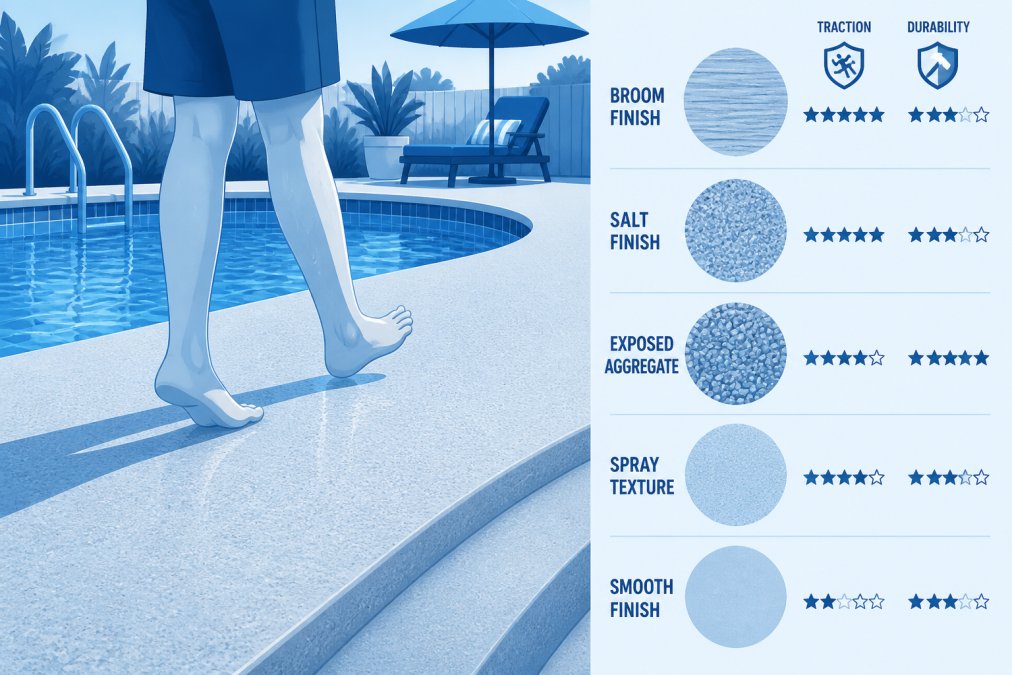
| Finish | Best For | Application | Approx. Starting Price |
|---|---|---|---|
| Kool Deck (Mortex) | Heat reduction, new installs | Professional | $5.50-$20/sq ft installed |
| FlexGround Polysplash | Commercial safety, ADA compliance | Professional | $8-$15/sq ft installed |
| SlipDoctors Deck Grip | Clear sealer, DIY | DIY or pro | $79.95/gallon |
| Tuff Coat UT-100 | Rubberized durability, color variety | DIY or pro | $115.99/gallon |
| DECK-O-GRIP | Colored concrete enhancement | DIY or pro | Quote-based |
| Seal-Krete Floor-Tex 40 | Budget textured coating | DIY or pro | $239.99-$299.99/40lb pail |
| Encore Coatings COOL! | Existing KoolDeck refresh | DIY | $259.00/5-gallon kit |
1. Kool Deck (Mortex): Best for Heat Reduction
Kool Deck is the gold standard for hot-climate pool decks. This cement-based topping reduces surface temperature by 20°F or more compared to standard concrete, making it genuinely walkable barefoot in direct sun. The textured, non-slip finish provides excellent traction in wet conditions and has a decades-long track record in residential and commercial installations.
The limitation is significant: Kool Deck cannot be applied over failing existing Kool Deck. If the old surface is delaminating or cracking, demolition is required before a new application.
Pros: Exceptional heat reduction, proven slip resistance, multiple color options, long lifespan
Cons: Professional installation required, cannot layer over failing existing surface, higher upfront cost
2. FlexGround Polysplash: Best for Commercial Safety
For HOA pools, hotel decks, and aquatic facilities where liability and ADA compliance are non-negotiable, FlexGround Polysplash is the most defensible choice. This rubberized surfacing system meets ADA slip-resistance standards and provides impact absorption that reduces injury severity if a fall occurs. UV and pool chemical resistance are built into the system. Expect a lifespan of 10-15 years with minimal maintenance.
Pros: ADA compliant, exceptional slip resistance, impact absorption, UV and chemical resistant, 10-15 year lifespan
Cons: Higher upfront cost, professional installation required
For commercial properties, request a written COF test report from any installer before signing a contract. FlexGround Polysplash’s ADA compliance documentation can serve as evidence of due diligence if a slip-and-fall claim is ever filed.
3. SlipDoctors Deck Grip: Best Clear Acrylic Sealer
SlipDoctors Deck Grip is the best non-slip solution for homeowners who want to preserve the existing look of their concrete or stone. This water-based acrylic sealer dries to a semi-gloss, barefoot-friendly finish while adding non-skid texture through its aggregate formula. It won’t yellow, resists pool chemicals and UV rays, and covers approximately 400 square feet per gallon.
Two to three thin coats are required for durable slip resistance, and the surface must be completely clean and dry before application.
Pros: Clear finish preserves surface appearance, UV and chemical resistant, DIY-friendly, non-yellowing
Cons: Requires 2-3 coats, strict surface prep requirements
4. Tuff Coat UT-100: Best Rubberized Coating
Tuff Coat UT-100 uses recycled rubber crumbs as its aggregate, creating a non-skid texture that is both effective and comfortable underfoot. The water-based, single-compound formula is VOC-free, which matters in enclosed or partially enclosed pool environments. With more than 20 color options, it’s one of the most versatile rubberized coatings on the market.
Coverage is relatively low at 40-45 square feet per gallon, so budget accordingly for larger decks. A Tuff Coat primer is required for best adhesion results.
Pros: VOC-free, flexible and chip-resistant, 20+ colors, hides surface imperfections
Cons: Low coverage rate, requires primer, higher per-gallon cost
5. DECK-O-GRIP: Best for Colored Concrete
DECK-O-GRIP is a high-solids acrylic sealer with a built-in slip-resistant additive, specifically formulated to seal and enhance colored concrete and exposed aggregate surfaces without yellowing. It’s VOC compliant and offers solid abrasion and stain resistance alongside pool chemical resistance.
Pricing requires a direct quote. Professional application is recommended for optimal results on large commercial surfaces.
Pros: Enhances colored concrete, non-yellowing, excellent non-skid qualities, chemical and weathering resistant
Cons: Pricing not publicly listed, professional application recommended
6. Seal-Krete Floor-Tex 40: Best Budget Textured Coating
Seal-Krete Floor-Tex 40 is the most accessible entry point for homeowners who need a durable, non-slip textured coating without a large upfront investment. The 40-pound pail provides a decorative, protective finish on concrete and masonry surfaces with meaningful texture for improved slip resistance.
Color options are more limited than tintable products, and the textured application requires more effort than a standard roller-applied sealer.
Pros: Budget-friendly, adds significant texture, protective layer against wear
Cons: Limited color options, more effort to apply, may require multiple pails for large areas
7. Encore Coatings COOL!: Best for Existing KoolDeck
Encore Coatings COOL! is specifically designed to work directly over existing KoolDeck or knockdown coatings, making it the right choice when the underlying surface is structurally sound but faded or uncomfortably hot. The system reduces surface temperature by 30-50% compared to standard concrete and accepts any gallon of standard paint for custom color matching.
Pros: Works over existing KoolDeck, dramatic heat reduction, customizable color, DIY-friendly
Cons: Requires mixing with a separate paint gallon, finish quality depends on applicator skill
Anti-Slip Additives for Pool Paint: A Practical Option
Anti-slip additives for pool paint offer a cost-effective way to boost traction without switching your entire coating system. Mix a granular or polymer additive into your existing sealer or deck paint before application, and the additive creates surface texture that raises the wet COF.
SureCrete SureGrip Additive is a well-regarded example at around $18 per quart. The key limitation is consistency. The texture level depends entirely on how thoroughly the additive is mixed and how evenly the base product is applied. For a DIY application on a small residential deck, additives are a legitimate option. For a commercial pool or large HOA facility, a purpose-built non-slip coating system is more reliable.
According to the National Floor Safety Institute’s guidelines on slip resistance, surface texture is one of the most controllable variables in pedestrian fall prevention, making proper additive mixing and application technique critical.
How to Apply Non-Slip Deck Sealer Correctly
Correct application is the difference between a coating that lasts a decade and one that peels within a season.
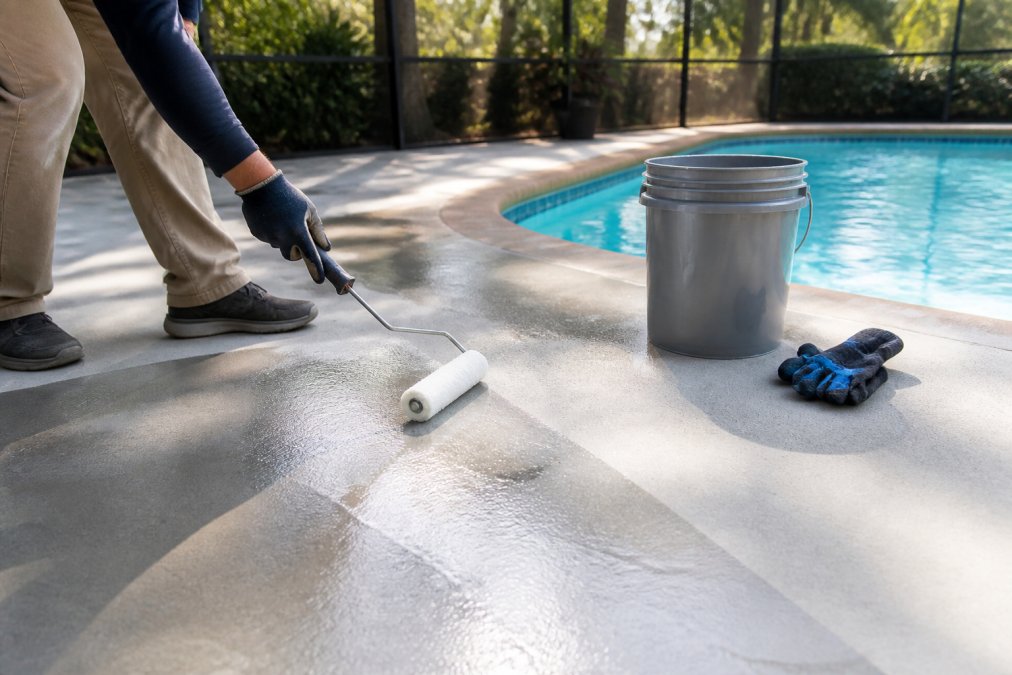
Surface Preparation: Acid Etching and Pressure Washing
Surface preparation is the single most important step in any pool deck resurfacing project. A coating applied to a contaminated, sealed, or structurally unsound concrete substrate will fail regardless of product quality.
The standard preparation sequence:
- Pressure wash the entire deck at 3,000 PSI minimum to remove dirt, algae, mold, and loose material
- Inspect for cracks and repair structural damage before any coating is applied
- Acid etch with a diluted muriatic acid solution (typically 1 part acid to 10 parts water) to open the concrete pores and improve adhesion
- Rinse thoroughly and allow the surface to dry completely, typically 24-48 hours depending on humidity
- Test for moisture using plastic sheeting taped to the surface overnight; visible condensation means the slab is not ready
Skipping acid etching on a previously sealed concrete substrate is the most common reason coatings delaminate prematurely.
DIY vs. Professional Application
Most clear acrylic sealers and additive-based products are genuinely DIY-friendly for homeowners with basic painting experience. Rubberized coatings like Tuff Coat UT-100 also fall within DIY capability for smaller decks.
Cement-based toppings like Kool Deck, rubberized systems like FlexGround Polysplash, and any application over structurally compromised concrete require professional application. A common mistake is applying a second coat before the first has fully cured. Most pool deck coatings require a minimum of 4-8 hours between coats and 24-72 hours before water exposure.
Pool Deck Resurfacing Cost: 10-Year Value Breakdown
The real cost of a pool deck finish isn’t the upfront price. It’s the total cost over a decade, including reapplication cycles, maintenance, and the cost of any failures.
A budget textured coating applied incorrectly might need reapplication every 2-3 years. A professionally installed Kool Deck or rubberized system, properly maintained, can last 10-15 years with only minor maintenance. Over a 10-year window, the math often favors the higher-quality initial installation.
| Finish Type | Typical Lifespan | Reapplication Frequency | Long-Term Cost Profile |
|---|---|---|---|
| DIY acrylic sealer | 2-4 years | Every 2-3 years | Low upfront, higher cumulative |
| Textured coating (DIY) | 3-5 years | Every 3-4 years | Moderate upfront and cumulative |
| Professional rubberized system | 10-15 years | Minimal touch-ups | Higher upfront, lower cumulative |
| Cement-based topping (Kool Deck) | 10-15 years | Occasional resealing | Higher upfront, lower cumulative |
According to the Consumer Product Safety Commission’s pool safety resources, pool-area slip-and-fall incidents represent a significant category of residential injury claims. The cost of a single liability incident typically exceeds the lifetime cost of a professional-grade surface installation by a wide margin.
For most residential decks, a professionally applied system with a 10-15 year lifespan costs less over time than cycling through budget coatings every 2-3 years. Factor in labor, downtime, and the risk of improper DIY application when comparing options.
Choosing the Right Non-Slip Pool Deck Finish for Your Situation
The right non-slip pool deck finish depends on four variables: your existing surface condition, your climate, your traffic volume, and your budget horizon.
For hot climates with barefoot comfort as the priority: Kool Deck or Encore Coatings COOL! are the clear choices. Kool Deck is the better long-term investment for new installations; COOL! is the practical choice when the existing surface is structurally sound.
For commercial properties and HOA facilities: FlexGround Polysplash is the most defensible choice because it meets ADA standards and provides documented COF performance.
For homeowners wanting a DIY clear sealer: SlipDoctors Deck Grip handles the job well on clean, properly prepared concrete while preserving surface appearance.
For surfaces with imperfections or color requirements: Tuff Coat UT-100 hides surface flaws while adding durable non-skid texture in a wide color range.
For tight budgets: Seal-Krete Floor-Tex 40 delivers real texture and protection at the lowest entry price in this list.
One thing that applies across every situation: the condition of the concrete substrate determines whether any coating succeeds. Deep cracks, delaminating sections, or active moisture intrusion must be addressed before resurfacing. As documented in ASTM International’s standards for slip-resistance testing, surface preparation and substrate integrity are consistently identified as primary factors in coating adhesion and long-term performance.
Worn concrete, peeling coatings, and surfaces that heat up to dangerous temperatures are exactly the problems Pool Decks R Us handles every day for residential and commercial clients. With an in-house crew that manages every project from structural crack repair through complete resurfacing, the work gets done correctly the first time, without subcontractors or shortcuts. Get a quote from Pool Decks R Us and find out which non-slip pool deck system is right for your specific surface and situation.
Frequently Asked Questions
What is the best non-slip coating for pool decking?
The best non-slip pool deck coating depends on your priorities. For heat reduction on bare feet, a cement-based topping like Kool Deck is hard to beat. For commercial properties needing ADA-compliant slip resistance, a rubberized surfacing system such as FlexGround Polysplash performs well. For a budget-friendly DIY option that maintains the original look of concrete, a clear acrylic sealer like SlipDoctors Deck Grip works effectively. Surface condition, traffic volume, and climate all affect which finish holds up longest.
How do I make my pool deck less slippery?
Start with proper surface preparation: pressure wash the concrete, repair any cracks, and etch the substrate so the coating bonds correctly. Then apply a non-slip pool deck finish with a meaningful coefficient of friction rating. Options range from clear acrylic sealers with built-in aggregate to full rubberized coatings. Anti-slip additives mixed into existing pool paint are a lower-cost upgrade. For cracked or failing surfaces, full resurfacing by a professional crew delivers longer-lasting slip resistance than a topcoat alone.
Are acrylic or epoxy coatings better for pool decks?
Acrylic sealers are generally preferred for outdoor pool decks exposed to UV rays and pool chemicals. They remain flexible through temperature swings, resist yellowing, and dry to a barefoot-friendly finish. Epoxy coatings offer excellent abrasion and stain resistance but can become slippery when wet unless a non-skid texture or aggregate is added. Epoxy also tends to chalk and fade faster under prolonged UV exposure. For most residential and commercial pool decks, a high-solids acrylic or a polyaspartic system offers better long-term performance outdoors.
How long do non-slip pool deck finishes last?
Lifespan varies by product type and how well the surface was prepared. Clear acrylic sealers typically last 2-5 years before reapplication is needed. Textured cement-based toppings like Kool Deck can last 10-15 years with proper maintenance. Rubberized surfacing systems such as FlexGround Polysplash are rated for 10-15 years. Aggregate finishes like PebbleTec can exceed 20 years. Professional application over a properly prepared concrete substrate consistently extends the life of any finish compared to DIY application.
How much does pool deck resurfacing cost?
Pool deck resurfacing cost depends on deck size, the condition of the existing concrete, the finish type chosen, and local labor rates. Cement-based toppings and rubberized systems installed professionally generally cost more upfront than a rolled-on acrylic sealer. However, a longer-lasting finish often costs less over a 10-year period when you factor in reapplication cycles. For an accurate estimate on your specific deck, request a quote from a qualified contractor who inspects the surface in person before pricing the job.
This article was written using GrandRanker