
Table of Contents
- Why Commercial Pool Deck Maintenance Can’t Wait
- Pool Deck Resurfacing, Coating, and Restoration Options
- ADA Compliance for Pool Decks: What Commercial Properties Must Know
- Preventative Maintenance Schedule for Pool Decks
- Pool Deck Resurfacing Cost: What Drives the Price
- Commercial Pool Deck Maintenance Done Right: The Pool Decks R Us Approach
- Conclusion
Last Updated: August 13, 2026
Why Commercial Pool Deck Maintenance Can’t Wait
Commercial pool deck maintenance gets deferred until something fails, a slip, an inspection violation, or a crack that becomes structural. Pool Decks R Us sees this pattern constantly across Central Florida, and the cost of waiting always exceeds the cost of acting early.
Commercial decks face higher foot traffic, greater liability exposure, and regulatory requirements than residential pools. Florida’s climate, heat, UV exposure, humidity, and wet-dry cycles, attacks concrete and coatings continuously. Early warning signs like surface discoloration can escalate into full structural restoration if ignored.
Common Problems on High-Traffic Pool Decks
Surface discoloration and minor scaling appear first, followed by cracking from thermal expansion and substrate movement. Moisture penetration then accelerates spalling and compromises structural integrity beneath the surface.
Other frequent problems include:
- Delaminating coatings from inadequate substrate preparation
- Loss of slip resistance as surface texture wears under constant foot traffic
- Drainage failures that create standing water and accelerate deterioration
- Efflorescence (mineral deposits) signaling ongoing moisture migration
Peeling or bubbling coatings are almost always a substrate preparation failure, not a product failure. The coating must come off and the substrate must be properly prepared before any new material is applied.
When Repairs Are Enough vs. Full Resurfacing
Isolated cracks with an otherwise sound surface can often be repaired and recoated. But when cracking is widespread, when significant spalling appears across multiple areas, or when drainage issues indicate substrate movement, resurfacing is more cost-effective long-term.
If more than roughly a quarter of the deck surface shows active damage, resurfacing outperforms piecemeal repairs over a five-year horizon.
Pool Deck Resurfacing, Coating, and Restoration Options
Surface restoration for commercial pool decks depends on the current concrete condition, foot traffic levels, and aesthetic requirements.
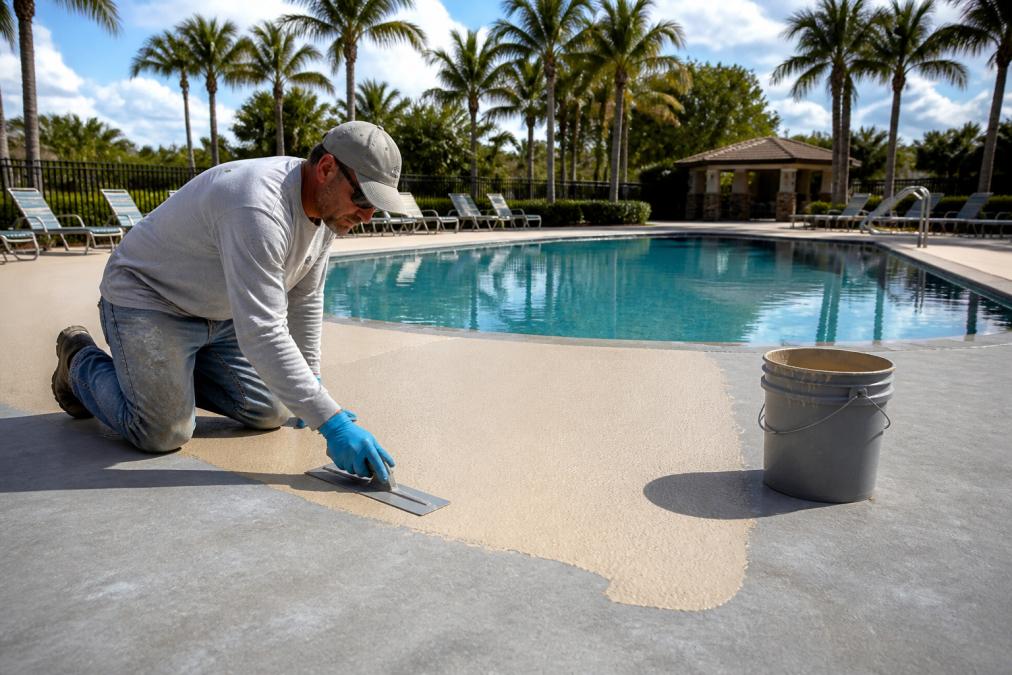
Concrete resurfacing overlays bond to existing concrete, filling voids and surface imperfections while providing a fresh base for coatings. Substrate preparation is critical: the surface must be clean, dry, and properly profiled before any material is applied. Skipping this step is the most common reason coatings fail prematurely.
Acrylic and Epoxy Coating Compared
Acrylic coatings are water-based, breathable, and UV-stable. They’re the standard for outdoor pool decks in high-sun climates, cure quickly, and offer a range of textures for slip resistance.
Epoxy coatings are solvent-based, extremely durable, and highly resistant to chemicals and abrasion. They excel in pump rooms and mechanical areas but aren’t UV-stable outdoors without a protective topcoat. For outdoor decks, epoxy serves as a base coat with a UV-protective topcoat.
| Coating Type | Best For | UV Stability | Cure Time | Texture Options |
|---|---|---|---|---|
| Acrylic | Outdoor pool decks | High | Fast (hours) | Fine to coarse |
| Epoxy (base) | High-wear, chemical zones | Low (needs topcoat) | Moderate | Limited |
| Epoxy + UV topcoat | High-traffic outdoor areas | High (with topcoat) | Moderate | Moderate |
Slip Resistance, UV Protection, and Surface Durability
Slip resistance is a primary design requirement on commercial pool decks. Texture is applied through aggregate broadcast, stamped or broom-finished overlays, or anti-slip additives mixed into the coating. The right specification balances safety with comfort and cleanability.
UV protection is equally critical in high-sun climates. Quality acrylic systems designed for outdoor use include UV inhibitors as standard, which is why they outperform generic coatings outdoors. According to the Concrete Network’s guide to pool deck coatings, properly specified acrylic systems can maintain performance for many years when maintained correctly.
ADA Compliance for Pool Decks: What Commercial Properties Must Know
ADA compliance for pool decks is a legal requirement for commercial properties. The Americans with Disabilities Act sets specific standards for accessible routes, surface conditions, and pool entry access.
Key requirements affecting pool deck surfaces include:
- Accessible routes must be continuous, firm, and stable, free of abrupt level changes exceeding 0.5 inches
- Surface slope on accessible routes must not exceed 1:20 (5%) running slope and 1:48 (2%) cross slope
- Pool lifts or sloped entries required at pools with more than 300 linear feet of pool wall
- Slip resistance on accessible routes must meet minimum standards
The ADA Standards for Accessible Design provide full technical specifications. Non-compliance exposes property owners to complaints, litigation, and required remediation.
Drainage correction ties directly to ADA compliance. Standing water on an accessible route is both a slip hazard and a potential violation.
Have your pool deck assessed for ADA compliance as part of any resurfacing project. Deck leveling and drainage correction can often be incorporated into the resurfacing scope at a fraction of standalone compliance work.
Preventative Maintenance Schedule for Pool Decks
A preventative maintenance schedule is the most cost-effective tool a commercial property manager has. The goal is catching surface deterioration early, when intervention is inexpensive, rather than at the point where full resurfacing becomes necessary.
Seasonal Maintenance Checklist for Central Florida Climates
Central Florida’s intense UV exposure, high humidity, frequent storms, and year-round pool use mean decks age faster than in cooler climates.
Quarterly (every 3 months):
- Pressure wash the entire deck surface
- Inspect expansion joints and cracks for new development
- Check drainage channels and drains for blockage
- Assess slip resistance in high-traffic areas
- Document surface condition with photographs
Annually:
- Professional inspection of coating adhesion and surface integrity
- Reseal or recoat worn areas before they become structural problems
- Verify ADA accessible route conditions
- Check for efflorescence or moisture migration signs
- Review drainage performance after heavy rainfall
After major storm events:
- Inspect for debris impact damage
- Check for new cracking or surface displacement
- Clear all drains and verify drainage function
Preventative Maintenance ROI: Protecting Your Investment
A consistent maintenance program extends the interval between major resurfacing projects, directly reducing annualized maintenance costs. Minor crack repair and recoating, when addressed early, costs a fraction of full resurfacing.
There’s also the liability dimension. According to the National Floor Safety Institute’s resources on slip and fall prevention, slip and fall incidents are among the leading causes of premises liability claims. A documented maintenance program is evidence of due diligence.
Preventative maintenance on a commercial pool deck is not a cost center. It’s a liability management strategy and a capital preservation strategy.
Pool Deck Resurfacing Cost: What Drives the Price
Pool deck resurfacing cost varies based on substrate condition, coating system selection, square footage, drainage and leveling work, and mobilization requirements.
Substrate condition is the variable most often underestimated. A deck requiring extensive crack repair, grinding, or moisture mitigation costs more than one needing only a surface refresh.
Coating system selection affects price significantly. Premium systems with UV stabilizers and anti-slip additives cost more than basic single-coat systems, but deliver better long-term performance.
Square footage ranges from a few hundred square feet at small complexes to several thousand at hotels or resorts. Per-square-foot pricing typically decreases at larger scales.
Drainage and leveling work adds to scope and is often necessary for ADA compliance and long-term performance.
For accurate pricing, a site assessment is essential. Contact Pool Decks R Us for a quote based on your actual deck.
Commercial Pool Deck Maintenance Done Right: The Pool Decks R Us Approach
Most pool deck failures trace to inadequate substrate preparation and materials not suited to the application.
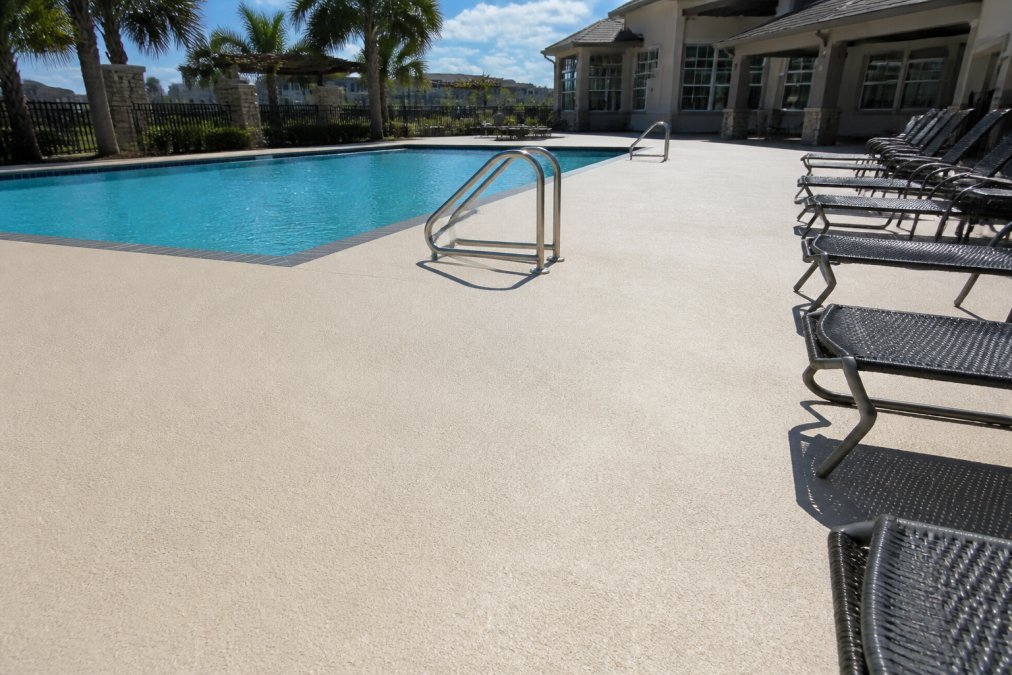
Pool Decks R Us handles commercial pool deck maintenance with an in-house crew on every job. No subcontracting, no hand-offs mid-project. The same team assessing your deck does the work, ensuring accountability throughout.
The focus on concrete pool deck repair and resurfacing means the crew brings specialist knowledge to every project. Commercial property managers working with generalist contractors often find pool deck work treated as a commodity. It isn’t. Substrate preparation, coating system selection, and ADA compliance require specific expertise.
The commitment is straightforward: get it right the first time. That means thorough substrate preparation, honest assessment of actual needs, and results that hold up under Central Florida conditions.
According to the Pool and Hot Tub Alliance’s guidelines for commercial aquatic facility maintenance, proper surface preparation and material selection are the two most critical factors in coating longevity. That’s the standard Pool Decks R Us works to on every project.
For commercial properties needing pool deck maintenance done properly, the starting point is a site assessment. Get in touch to schedule yours.
Commercial pool deck maintenance is a recurring responsibility, not a one-time fix. Florida’s climate, high foot traffic, and regulatory requirements mean a proactive approach always outperforms reactive repair. Properties that manage this well treat their pool decks as assets to be maintained.
Pool Decks R Us brings specialist concrete pool deck expertise, an in-house crew, and a commitment to lasting results to every commercial project. Get A Quote today and find out exactly what your deck needs.
Frequently Asked Questions
How long does pool deck resurfacing last on a commercial property?
A professionally applied pool deck resurfacing job typically lasts 8 to 15 years on commercial surfaces, depending on the coating system used, foot traffic volume, and how consistently the deck receives preventative maintenance. Proper substrate preparation before application is the single biggest factor in longevity. Surfaces that skip this step tend to see peeling or delamination within the first year or two, which is why thorough prep work matters as much as the coating itself.
What are the OSHA and ADA safety requirements for commercial pool decks?
OSHA General Industry standards require that walking surfaces be kept free of hazards including cracks, uneven surfaces, and slippery conditions. The ADA Standards for Accessible Design (2010) require that pool deck surfaces along accessible routes have a slip-resistant finish and meet specific cross-slope and running-slope limits. Commercial properties must also provide accessible pool entry points. Failing to meet these standards creates liability exposure and can trigger enforcement action during inspections.
How much does commercial pool deck resurfacing cost?
Pool deck resurfacing cost for commercial properties depends on several variables: total square footage, the condition of the existing concrete, the coating system selected, and whether drainage correction or crack repair is needed before resurfacing begins. Because no two decks are in the same condition, a site assessment is the only reliable way to get an accurate figure. Contact Pool Decks R Us for a detailed quote based on your property's actual scope of work.
Can deep cracks and spalling concrete be repaired, or does the deck need full replacement?
Most cracked and spalling commercial pool decks can be restored without full demolition. Structural crack repair, concrete refinishing, and proper substrate preparation can address even significant surface damage. Full replacement is typically only necessary when the underlying slab has shifted, heaved, or lost structural integrity across large sections. A professional assessment will determine which approach applies to your deck, saving you from unnecessary replacement costs.
This article was written using GrandRanker