Table of Contents
- Why Heat-Reflective Pool Deck Coatings Matter
- Top Pool Deck Coatings for Heat Reduction: Quick Comparison
- 1. Encore Coatings COOL!: Best for DIY Heat Reduction
- 2. Mortex Kool Deck Elite: Original Heat-Reducing Topping
- 3. H&C Cool Feel Water-Based Acrylic: Chemical-Resistant Option
- Non-Slip Pool Deck Paint and Safety Features
- How to Apply Pool Deck Coating: Preparation and Process
- Cool Deck Resurfacing Cost: What to Budget
Last Updated: August 17, 2026
Why Heat-Reflective Pool Deck Coatings Matter
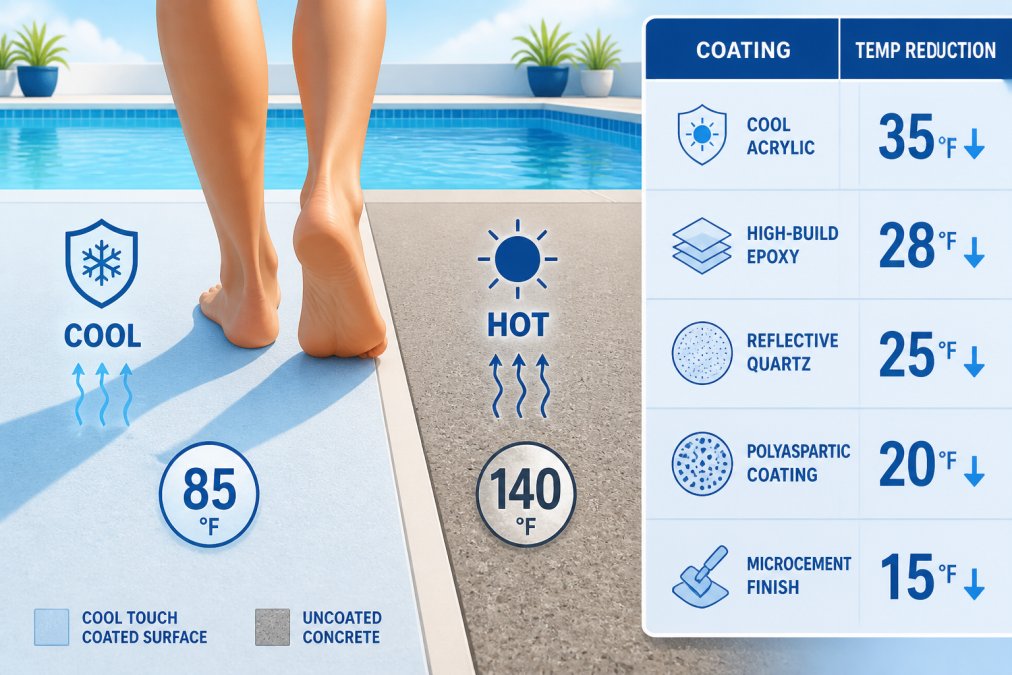
When temperatures hit 95 degrees, untreated concrete pool decks can exceed 140 degrees in direct sunlight, making them uncomfortable and dangerous. Heat-reflective pool deck coatings solve this by reflecting solar radiation rather than absorbing it, keeping surfaces significantly cooler while improving safety and durability.
Modern coatings reduce surface temperatures substantially, add slip resistance, and protect concrete from UV damage and chemical degradation. This guide covers the best options available today, from DIY-friendly solutions to professional resurfacing systems, helping you choose the right coating for your situation.
Heat-reflective coatings reduce surface temperature by 30-40% compared to bare concrete, making the difference between a usable pool deck and one that’s painfully hot to walk on.
Top Pool Deck Coatings for Heat Reduction: Quick Comparison
The key variables are budget, whether you’re comfortable applying the coating yourself, and how important long-term durability is. A $259 DIY kit might solve the heat problem temporarily, but if it peels after two seasons, you’re back where you started. Professional resurfacing systems cost more upfront but often last 15+ years with minimal maintenance.
| Coating | Type | Temperature Reduction | Best For | Application |
|---|---|---|---|---|
| Encore Coatings COOL! | Liquid acrylic | Up to 38% | DIY, budget-conscious | Self-applied, tintable |
| Mortex Kool Deck Elite | Dry topping | Significant | Residential, durability | Pre-mixed, dash brush |
| H&C Cool Feel Water-Based | Acrylic polymer | Moderate to significant | Chemical resistance | Self-applied or professional |
| SUNDEK Classic Texture | Textured acrylic | Significant | Custom aesthetics | Professional installation |
| FlexGround Polysplash | Rubberized system | Significant | Comfort + safety | Professional installation |
Each has trade-offs. DIY options are cheaper but require careful surface prep. Professional systems cost more but eliminate application risk and often include warranties.
1. Encore Coatings COOL!: Best for DIY Heat Reduction
Encore’s COOL! coating is the standout choice for handling the job yourself with real temperature reduction. The product reduces surface temperature by up to 38% compared to standard concrete. The kit comes as a 5-gallon pail covering approximately 200 square feet and is tintable to any color. It’s waterproof, resists UV damage, holds up against pool chemicals, and provides ADA-compliant slip resistance.
At around $259 per kit, the price point is manageable for most homeowners. Application is straightforward for someone with basic DIY skills, though surface preparation is non-negotiable. The coating repairs small cracks and chips as it goes, adding protection.
Coverage can fall short of advertised specs on heavily textured concrete, and longevity depends heavily on substrate preparation. Poor prep work leads to peeling.
Pressure wash your deck 48 hours before application and let it dry completely. Any moisture trapped under the coating will cause adhesion failure. This single step determines whether your coating lasts 3 years or 8 years.
2. Mortex Kool Deck Elite: Original Heat-Reducing Topping
Mortex Kool Deck Elite is the original heat-reducing concrete topping with an earned reputation. This dry topping system mixes with water on site, making it more forgiving than liquid coatings. The formula is specifically designed to lower surface temperature while creating a durable, non-skid surface that resists chemical attacks and craze cracking.
The pre-mixed formula simplifies the process compared to measuring multiple components. It handles thermal shock when cool water splashes onto hot concrete, a real problem that causes many coatings to fail prematurely.
Application requires a dash brush technique with a learning curve, and you’ll purchase the color unit separately, adding to total cost. The product is heavier and more labor-intensive than liquid coatings.
3. H&C Cool Feel Water-Based Acrylic: Chemical-Resistant Option
H&C’s Cool Feel coating uses Comfort Step Technology to reduce surface temperature while maintaining excellent resistance to pool chemicals and UV rays. This water-based acrylic means easier cleanup and lower VOC emissions. The coating is available in hundreds of tintable colors through Sherwin-Williams, giving significant aesthetic flexibility.
Temperature reduction varies based on color choice. Lighter colors reflect more heat, so darker shades sacrifice some temperature reduction for aesthetics. Some users report reapplication is necessary after several years in harsh climates.
Darker colors reduce the heat-reflection benefit significantly. If temperature reduction is your primary goal, stick with light colors like white, cream, or light gray.
Non-Slip Pool Deck Paint and Safety Features
Safety around a pool deck is non-negotiable. Slip resistance is built into nearly every modern pool deck coating through texture. Liquid coatings like Encore and H&C Cool Feel include aggregate or texture additives that create a rough surface. Dry toppings like Mortex Kool Deck Elite have inherent texture from their composition.
FlexGround’s rubberized surface is naturally slip-resistant and provides cushioning underfoot, valuable if you have older adults or children using the pool. The trade-off is cost: professional installation runs $10-15 per square foot.
ADA compliance is relevant for commercial properties or HOA facilities. Most modern coatings meet ADA slip-resistance standards (ASTM D2047), but verify this with the product spec sheet before purchasing.
How to Apply Pool Deck Coating: Preparation and Process
Application quality determines whether your coating lasts two years or ten. The most common failure point is inadequate substrate preparation. Concrete that’s dirty, wet, or improperly etched won’t bond properly to the coating.
Preparation Steps:
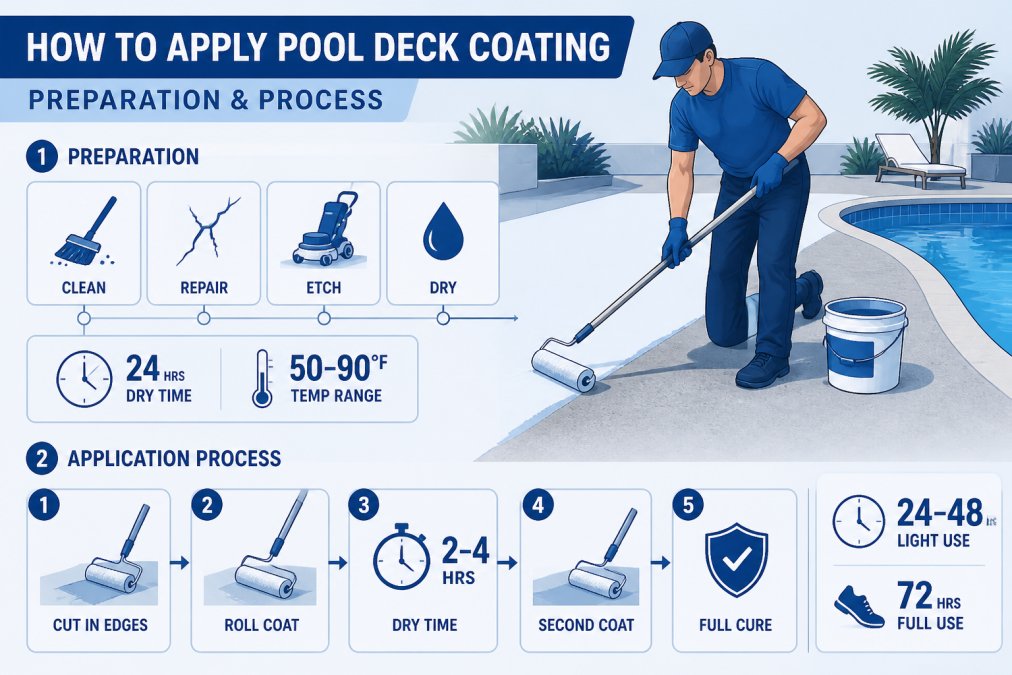
Start with a thorough pressure wash at 3000+ PSI to remove dirt, algae, and loose concrete. Let the deck dry completely for at least 48 hours. If dealing with existing sealers or coatings, they need removal through grinding or chemical stripping.
Check for cracks wider than 1/8 inch and fill them with concrete patching compound. Acid etching opens the pores so the coating bonds properly. Use a concrete etcher following product instructions, then rinse thoroughly and let dry.
Application Process:
Most liquid coatings are applied with a roller or brush in thin, even coats. Two coats are standard. Follow manufacturer’s cure time between coats. For dry toppings like Mortex, mix powder with water to correct consistency and apply with a dash brush using a stippling motion.
Temperature matters. Apply when ambient temperature is between 50 and 85 degrees Fahrenheit. Avoid application on days with rain forecast within 24 hours of completion.
Apply thin coats rather than one thick coat. Two thin coats outperform one thick coat every time.
Curing and Maintenance:
Most coatings require 48-72 hours of cure time before foot traffic. Keep the area dry during this window. Once cured, regular rinsing removes algae and debris. Avoid harsh chemicals or pressure washing in the first season.
Cool Deck Resurfacing Cost: What to Budget
DIY liquid coatings are the most affordable entry point. A 5-gallon kit of Encore COOL! runs around $259 and covers 200 square feet, roughly $1.30 per square foot in materials. For a 400-square-foot deck, you’re looking at $518 in coating plus tools and prep materials.
Dry toppings like Mortex Kool Deck Elite are similar in material cost but require more labor. A 50-pound bag is around $55, with approximately one bag per 30-50 square feet.
Professional installation changes the equation significantly. Textured systems like SUNDEK typically run $4-25 per square foot installed, meaning a 400-square-foot deck costs $1,600-10,000. Rubberized systems like FlexGround are $10-15 per square foot, putting the same deck at $4,000-6,000.
A DIY coating that fails after three years costs double the original investment. A professional system with a 10-year warranty might cost more upfront but eliminates reapplication risk.
Pool Decks R Us can assess your specific deck and provide a detailed quote for both residential and commercial properties. We handle everything from structural repairs to complete resurfacing. Get a quote today.
Choosing the right pool deck coating for heat comes down to budget, comfort with DIY work, and desired longevity. Encore COOL! is the smart choice if you’re handy and want to save money. Mortex Kool Deck Elite works well if you want a proven product with durability. H&C Cool Feel is your option if chemical resistance and color variety matter most.
For the best long-term results with zero application risk, professional resurfacing through Pool Decks R Us ensures lasting results done right the first time. Our in-house crew handles residential and commercial properties throughout the region. Get a quote today to transform your pool deck into a cool, safe, and beautiful outdoor space.
Frequently Asked Questions
What is the best heat-resistant paint for pool decks?
Heat-reflective acrylic and polymer-based coatings like Encore Coatings COOL! and H&C Cool Feel reduce surface temperature by 35-38% through high solar reflectance and thermal emissivity properties. Mortex Kool Deck Elite offers a topping system specifically formulated for heat reduction. The best choice depends on whether you want a DIY-friendly coating or professional installation, and your budget for pool deck resurfacing cost. Look for products with proven thermal performance data and slip-resistant properties for safety.
How do cool deck coatings work to reduce surface temperature?
Cool deck coatings use high solar reflectance and thermal emissivity to bounce heat away from the surface rather than absorbing it. Acrylic polymers and mineral aggregates in these coatings reflect sunlight and dissipate heat more effectively than bare concrete. The textured or light-colored surface finish also plays a role in reducing heat build-up. When properly applied with correct mil thickness and adequate topcoat, these coatings can lower surface temperature by 30-40 degrees compared to standard concrete, making the deck comfortable for bare feet.
What's the difference between non-slip pool deck paint and regular coatings?
Non-slip pool deck paint contains aggregate particles or textured additives that increase friction and grip, even when wet. These coatings meet ADA slip-resistance standards and are essential for safety around water. Regular coatings may be smooth and slippery when wet. Most heat-reflective pool deck coatings include slip-resistant properties, but verify the product meets slip-resistance testing standards. Proper application and maintenance of the topcoat layer preserve these safety features over time.
How long does pool deck coating last before needing reapplication?
Most acrylic and polymer-based pool deck coatings last 5-10 years with proper maintenance, depending on climate, UV exposure, and chemical exposure from pool water. Water-based acrylic coatings may require reapplication sooner in harsh Florida climates with intense sun and humidity. Concrete toppings like Mortex Kool Deck Elite typically last longer due to their thicker application and cement-based formula. Regular pressure washing, avoiding harsh chemicals, and addressing cracks quickly extend coating lifespan. Professional installation and quality substrate preparation significantly impact durability.
This article was written using GrandRanker