
Table of Contents
- Common Pool Deck Problems: Cracks, Spalling, and Uneven Slabs
- Concrete Pool Deck Crack Repair: What the Process Actually Involves
- DIY vs Professional Pool Deck Repair: An Honest Cost-Benefit Look
- Pool Deck Resurfacing: Finishes, Coatings, and Material Options
- Pool Deck Resurfacing Cost: What Drives the Price
- Residential and Commercial Pool Deck Repair Services
- How to Get a Free Estimate from Pool Decks R Us
- Conclusion
Last Updated: August 14, 2026
Pool deck repair is one of those home improvement projects that homeowners put off until they absolutely can’t anymore. At Pool Decks R Us, we’ve worked on hundreds of residential and commercial decks across Central Florida, and the pattern is consistent: the longer a problem goes unaddressed, the more expensive and disruptive the fix becomes. This guide covers everything you need to know about residential pool deck repair services, from diagnosing what’s wrong with your slab to understanding the repair process and what drives the final cost.
Common Pool Deck Problems: Cracks, Spalling, and Uneven Slabs
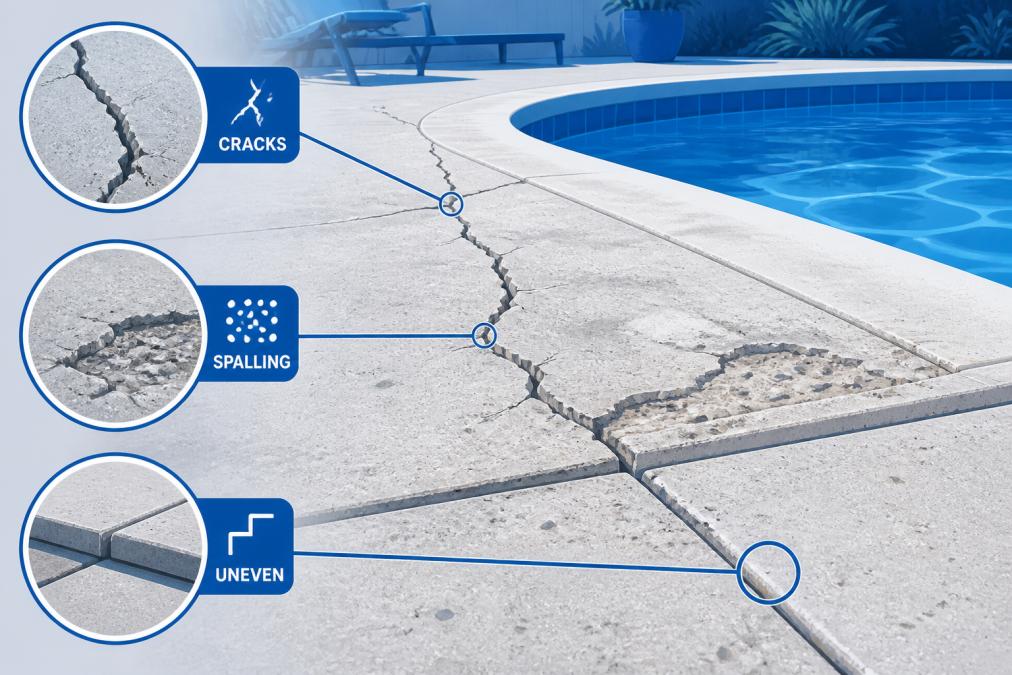
Most pool deck damage falls into three categories.
Cracks are the most visible sign of trouble. Hairline cracks are often cosmetic, but wider cracks, especially those running across expansion joints or forming a pattern, typically signal substrate movement or moisture infiltration. Water works into those gaps, freezes, and widens them further.
Spalling is the technical term for concrete that’s flaking, pitting, or breaking apart at the surface. It happens when the surface layer separates from the substrate below, usually because of moisture cycling, a poor original mix, or a coating that failed to bond properly.
Uneven slabs are the most structurally significant problem. When sections of your deck settle at different rates, you get trip hazards, drainage problems, and stress fractures. The underlying cause is almost always soil movement, which in Central Florida is a near-constant reality.
Why Florida’s Climate Accelerates Deck Damage
Florida’s combination of intense UV radiation, heavy rainfall, and high humidity creates conditions that are hostile to concrete pool decks. The sun drives thermal expansion and contraction daily. Rain saturates the soil beneath slabs, causing shifting. Humidity prevents surfaces from fully drying between rain events, accelerating the breakdown of coatings and sealers.
The Florida Building Code requirements for pool deck construction exist precisely because the state’s climate demands materials and methods that go beyond standard residential concrete work. Decks installed without proper drainage planning or appropriate concrete mixes show significant deterioration within five to ten years. Decks done correctly can last decades with periodic maintenance.
Damage you’re seeing now almost certainly started developing years ago. Addressing it sooner rather than later preserves your options and keeps costs manageable.
Concrete Pool Deck Crack Repair: What the Process Actually Involves
Concrete pool deck crack repair is not simply filling a gap with caulk and calling it done. A proper repair process addresses the cause of the crack, not just the symptom.
Substrate Preparation and Structural Assessment
Before any material goes into a crack, a qualified contractor needs to assess what caused it. Cracks from soil settlement require a different approach than cracks from surface shrinkage or thermal movement. Skipping this step is the single most common reason pool deck repairs fail prematurely.
Substrate preparation typically involves pressure washing the entire deck to remove algae, dirt, and loose material. Grinding or shot-blasting may be used to open the crack and create a clean bonding surface. Any structurally compromised concrete must be removed before resurfacing. According to the American Concrete Institute’s guidance on concrete repair, proper substrate preparation accounts for the majority of a repair’s long-term success.
Crack Injection, Leveling, and Surface Restoration
For structural cracks, crack injection using polyurethane foam or epoxy is the standard approach. Polyurethane foam injection, sometimes called concrete lifting or slab jacking, is particularly effective for cracks caused by soil voids beneath the slab. The foam expands to fill the void, stabilizes the substrate, and lifts settled sections back toward their original position with minimal disruption.
For surface-level cracks and spalling, the repair involves applying a bonding agent followed by a polymer-modified concrete overlay. Pool deck leveling addresses uneven slabs by using polyurethane foam injection to lift settled sections incrementally until the surface is level. This approach is far less disruptive than traditional mudjacking and cures quickly enough that most decks are usable within hours.
Surface restoration, the final step, involves applying a texture coating or acrylic deck coating that seals the repaired surface, restores appearance, and provides the slip resistance required for a safe pool environment.
DIY vs Professional Pool Deck Repair: An Honest Cost-Benefit Look
For minor cosmetic issues, DIY pool deck repair is viable. Hairline surface cracks can be filled with a concrete crack filler available at any home improvement store. Resealing a deck in otherwise good condition is a reasonable weekend project.
The line gets crossed when you’re dealing with cracks wider than a quarter-inch, spalling that covers more than a small area, any section that has shifted or settled, or coating failures where the existing surface is delaminating. At that point, the problem is structural, not cosmetic. DIY repairs on structural issues typically mask the problem for a season before failing, often making the underlying condition worse and the professional repair more expensive.
A professionally executed concrete pool deck crack repair, done with proper substrate preparation and quality materials, typically lasts many years before needing attention. Over a five to ten year horizon, the professional repair almost always costs less per year of service life.
The most expensive pool deck repairs we see are on decks where a homeowner or low-bid contractor applied a new coating over a failing substrate. The coating traps moisture, accelerates the underlying damage, and eventually the entire surface needs to be stripped before proper repair can begin. Skipping substrate assessment to save money upfront routinely doubles the eventual repair cost.
| Repair Type | DIY Suitable? | Professional Recommended? | Why |
|---|---|---|---|
| Hairline surface cracks | Yes | Optional | Cosmetic only, low risk |
| Spalling over small area | With care | Preferred | Surface prep is critical |
| Wide or structural cracks | No | Required | Cause must be diagnosed |
| Settled or uneven slabs | No | Required | Requires foam injection or grinding |
| Full deck resurfacing | No | Required | Bonding failure risk is high |
Pool Deck Resurfacing: Finishes, Coatings, and Material Options
Pool deck resurfacing is not one product. It’s a category of solutions, and the right choice depends on your existing surface condition, aesthetic goals, budget, and climate.
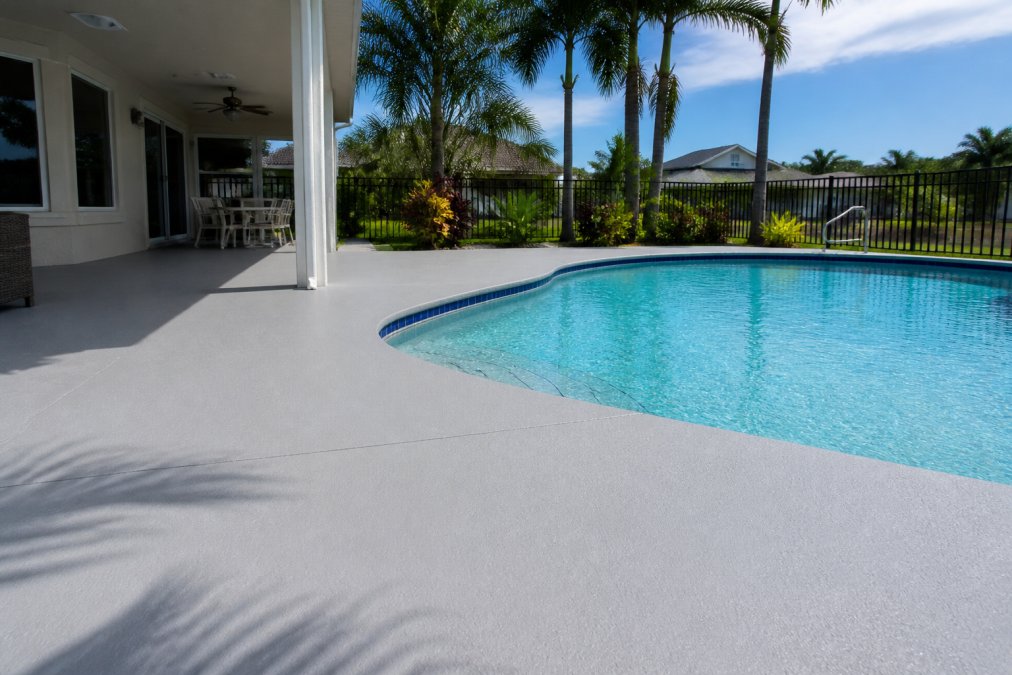
Acrylic deck coatings are the most common choice for residential pool decks. They bond well to prepared concrete, come in a range of textures and colors, and offer good waterproofing performance. Quality acrylic coatings include aggregate additives that create the textured, slip-resistant surface required around pools.
Stamped concrete overlays create the appearance of stone, brick, or tile using a concrete-based material applied over the existing slab. This is a popular option for homeowners who want a significant aesthetic upgrade without tearing out the existing deck.
Polyurea and polyaspartic coatings are a higher-performance option. These materials cure faster than epoxy, bond more flexibly to the substrate, and hold up better under UV exposure.
Paver sealing applies to decks with brick or concrete pavers rather than poured slabs. Sealing protects the joint material, prevents staining, and can restore color to faded pavers.
Slip-Resistance, Heat Reflection, and Safety Standards
Two performance requirements matter more than aesthetics for any pool deck surface: slip resistance and heat management.
The Americans with Disabilities Act accessibility guidelines for wet surfaces and the ASTM International standards for slip resistance on walkway surfaces both establish minimum traction requirements for surfaces in wet areas. A pool deck that doesn’t meet these thresholds is a liability. Proper texture coatings, applied at the right thickness and aggregate density, are what make a surface compliant.
Heat reflection is a quality-of-life issue that Florida homeowners feel acutely. Standard gray concrete absorbs heat and can become painful to walk on barefoot during summer afternoons. Heat-reflective finishes keep surface temperatures meaningfully lower than untreated concrete.
When evaluating resurfacing options, ask specifically about the coefficient of friction rating for the finish being proposed. A higher rating means better slip resistance when wet. Any reputable contractor should be able to provide this specification for the products they use.
Pool Deck Resurfacing Cost: What Drives the Price
Pool deck resurfacing cost varies considerably based on factors specific to each project. Any quote you receive should reflect a site assessment, not a per-square-foot rate pulled from a price sheet.
The variables that drive cost most significantly:
Existing condition of the substrate. A deck in good structural condition that needs cosmetic resurfacing costs substantially less than one requiring crack injection, leveling, and spalling repair before a coating can be applied.
Size of the deck. Larger decks cost more in absolute terms, though the per-square-foot cost often decreases at scale.
Material selection. A basic acrylic coating costs less than a stamped concrete overlay or a polyaspartic system.
Drainage and structural issues. If the deck has drainage problems or sections need to be lifted and releveled before resurfacing, those are additional line items.
Access and site conditions. Tight access, obstacles around the pool, or the need to work around landscaping all affect the time required and therefore the cost.
Pool Decks R Us provides transparent, itemized estimates so you understand exactly what you’re paying for before any work begins. There are no subcontractors involved, which means no markup layers and no surprises when the crew shows up.
Residential and Commercial Pool Deck Repair Services
The difference between a residential pool deck repair and a commercial one is mostly a matter of scale, timeline, and the stakes involved if something goes wrong.
Residential projects typically involve a few hundred square feet of surface area. The homeowner wants the work done efficiently, with minimal disruption, and results that hold up for years.
Commercial projects, community pools for HOAs, hotel and resort pool areas, apartment complex decks, and fitness center aquatic facilities involve larger surface areas and tighter operational constraints. A hotel cannot close its pool for two weeks. These projects require contractors who can plan phased work, meet deadlines, and produce results that hold up under heavy use.
The structural requirements are also more demanding for commercial applications. Slip resistance standards matter more when hundreds of guests use a surface daily. Waterproofing and drainage need to perform reliably under continuous exposure. The coating system needs to withstand commercial cleaning chemicals and high foot traffic.
Pool Decks R Us handles both residential and commercial pool deck repair with the same in-house crew. No subcontractors, no handoffs, no accountability gaps.
For HOA boards and property managers evaluating contractors, the most important question to ask is whether the work will be performed by the company’s own employees or subcontracted out. Subcontracting introduces quality control variables that are difficult to manage and even harder to address after the fact.
How to Get a Free Estimate from Pool Decks R Us
Getting an accurate estimate for pool deck repair services starts with a site visit. No reputable contractor can give you a meaningful number based on a phone call or photos, because the condition of the substrate, the extent of the damage, and site-specific variables all require eyes on the actual deck.
The estimate process at Pool Decks R Us works like this:
- Contact us to schedule a site visit at a time that works for you
- Walk the deck together so you can show us exactly what concerns you and ask questions directly
- Receive an honest assessment of what the deck actually needs, including whether a full resurface is warranted or whether targeted repairs will solve the problem
- Get a written estimate that breaks down the scope of work, materials, and timeline before you commit to anything
There’s no obligation and no pressure. If targeted crack repair is all your deck needs, that’s what we’ll recommend. If the substrate is too far gone for a coating to perform well, we’ll tell you that too, because a coating applied over a failing surface is money wasted.
Worn-out concrete and failing coatings are fixable problems, but only when the repair is done correctly from the substrate up. Pool Decks R Us specializes in concrete pool deck repairs and full resurfacing for residential and commercial properties, with an in-house crew that handles every step of the process. From structural crack repair and concrete lifting to heat-reflective coatings and slip-resistant finishes, the work is done right the first time. Get A Quote today and find out exactly what your deck needs and what it will take to get it there.
Frequently Asked Questions
Is it common for pool decks to crack?
Yes, cracking is one of the most frequent pool deck repair issues homeowners face. Concrete expands and contracts with temperature swings, and the intense heat and frequent rain in Florida accelerate that cycle. Ground movement and soil erosion beneath the slab also contribute. Hairline cracks are normal over time, but wider or deepening cracks signal a structural problem that needs professional attention before resurfacing can be applied successfully.
How much does pool deck resurfacing cost?
Pool deck resurfacing cost varies based on the deck's size, the severity of existing damage, the coating or finish selected, and the amount of substrate preparation required. Structural crack repair, concrete leveling, and premium decorative finishes each add to the total. Because every deck is different, the most accurate way to understand your specific cost is to request a free on-site estimate so the contractor can assess conditions directly before quoting.
What are the signs that a pool deck needs professional repair?
Watch for cracks wider than a hairline, sections of concrete that feel hollow underfoot, visible spalling or flaking on the surface, standing water that won't drain, or coating that is peeling and bubbling. Any of these indicate the deck's structural integrity or waterproofing has been compromised. Attempting a surface-only fix without addressing the underlying issue is a common reason coatings fail within months of application.
What is the best material for a pool deck in Florida?
Acrylic texture coatings, polyurea, and polyaspartic finishes perform well in Florida's climate because they resist UV degradation, handle thermal expansion, and can be formulated with slip-resistant texture. Stamped concrete with a sealed finish is also popular for its decorative appeal. The right choice depends on your existing substrate, budget, and how much foot traffic the deck handles. A professional assessment helps match the material to your specific conditions.
This article was written using GrandRanker